
REFINE YOUR RESULTS
Filter Lifting Clamps
Select any combination below, then apply the filters.
Showing 1–24 of 89 results
-
View ItemLifting Clamps
Terrier 0.5 metric ton TSCC Universal Screw Clamp (900500) – 1,100 lb capacity
$477.85 - View Item
- View Item
- View Item
- View Item
-
View ItemLifting Clamps
Terrier 1 metric ton TSCC-W Universal Screw Clamp (862711) – 2,200 lb capacity
$1,408.40 -
View ItemLifting Clamps
Terrier 1 metric ton TSE Fixed-Eye Vertical Plate Lifting Clamp (850880) – 2,200 lb capacity
$518.70 - View Item
-
View ItemLifting Clamps
Terrier 1.5 metric tons TSCC Universal Screw Clamp (901500) – 3,300 lb capacity
$774.25 - View Item
- View Item
-
View ItemLifting Clamps
Terrier 12 metric tons FHSX Horizontal Plate Lifting Clamp (954012) – 26,400 lb capacity per Pair
$1,080.35 - View Item
-
View ItemLifting Clamps
Terrier 12 metric tons STS Fixed-Eye Vertical Plate Lifting Clamp (852401) – 26,400 lb capacity
$1,985.40 -
View ItemLifting Clamps
Terrier 12 metric tons STSU Universal Vertical Plate Lifting Clamp (856401) – 26,400 lb capacity
$3,697.95 -
View ItemLifting Clamps
Terrier 12 metric tons TS Fixed-Eye Vertical Plate Lifting Clamp (850501) – 26,400 lb capacity
$1,679.60 -
View ItemLifting Clamps
Terrier 12 metric tons TSU Universal Vertical Plate Lifting Clamp (865901) – 26,400 lb capacity
$2,466.95 -
View ItemLifting Clamps
Terrier 15 metric tons FHSX Horizontal Plate Lifting Clamp (853820) – 33,000 lb capacity per Pair
$2,185.95 -
View ItemLifting Clamps
Terrier 15 metric tons FHX Horizontal Plate Lifting Clamp (953015) – 33,000 lb capacity per Pair
$1,410.95 -
View ItemLifting Clamps
Terrier 15 metric tons STS Fixed-Eye Vertical Plate Lifting Clamp (921500) – 33,000 lb capacity
$3,943.80 -
View ItemLifting Clamps
Terrier 15 metric tons STSU Universal Vertical Plate Lifting Clamp (966150) – 33,000 lb capacity
$4,816.65 -
View ItemLifting Clamps
Terrier 15 metric tons TS Fixed-Eye Vertical Plate Lifting Clamp (915000) – 33,000 lb capacity
$3,432.50 -
View ItemLifting Clamps
Terrier 15 metric tons TSU Universal Vertical Plate Lifting Clamp (955150) – 33,000 lb capacity
$4,377.85 -
View ItemLifting Clamps
Terrier 17 metric tons TS Fixed-Eye Vertical Plate Lifting Clamp (917000) – 37,400 lb capacity
$5,010.10
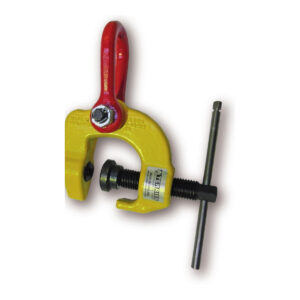
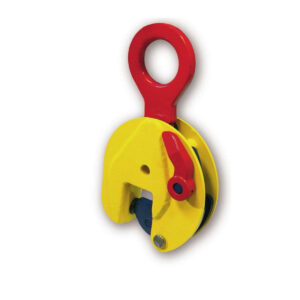
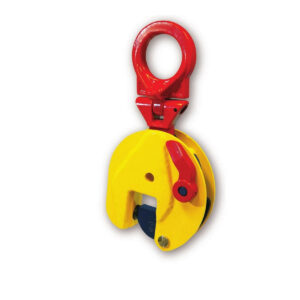
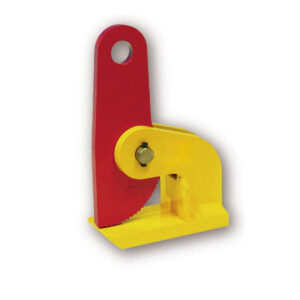
Plate Lifting Clamps (Renfroe and Terrier) — Engineering Reference and Buyer’s Guide
Slings Unlimited supplies Renfroe and Terrier steel plate lifting clamps for structural fabricators, shipyards, service centers, and machine shops. The types available are locking screw clamps, vertical locking plate clamps, and horizontal plate clamps, and the manufacturers document them to ASME B30.20 (Below-the-Hook Lifting Devices). Capacities in this catalog run from 0.5 ton (1,000 lbs) on the Renfroe models to 30 metric tons (66,000 lbs) on the largest Terrier vertical clamps.
Vertical locking plate clamps
Renfroe Model FR is a vertical-only locking clamp with a lock-closed feature. Model L turns a single plate through a 90° arc, and Model JPA turns a single plate through a 180° arc, with side-load ratings published by Renfroe. Terrier TS, STS, and TSE are fixed-eye vertical clamps; TSU, STSU, and TSEU are universal clamps with an articulated shackle. Terrier’s vertical cam clamps pretension the cam on the plate so the clamp does not slip when the load is taken up, and they lock in both the open and the closed position.
Locking screw clamps
Renfroe Model SCPA is a locking screw clamp that can take a plate from horizontal to vertical through a 180° arc, using a spring-loaded pivoting cam jaw that cams in when load is applied to the shackle. Model RSC is a lighter screw clamp for thicker plate up to 3" at 0.5 ton (1,000 lbs). Terrier TSCC and TSCC-W screw clamps are for vertical and horizontal lifting of steel structures; they have no minimum load, and a movable cam on the screw spindle holds the workpiece when the screw is tightened.
Horizontal plate clamps (used in pairs)
Terrier FHX and FHSX clamps are for lifting a single, non-deflecting steel plate horizontally and must be used in pairs or in multiple pairs. They are not for stacks or bundles. Terrier rates these clamps at full capacity when the angle between the sling legs is no more than 60° (a 60° or steeper sling angle from the horizontal).
| Brand / family | Clamp type | Capacity | Jaw / plate thickness |
|---|---|---|---|
| Renfroe FR (4 products) | Vertical only | 0.5 ton to 3 tons (1,000 lbs to 6,000 lbs) | 0" to 1-1/4" |
| Renfroe JPA (3 products) | Vertical, 180° turn and side pull | 0.5 ton to 2 tons (1,000 lbs to 4,000 lbs) | 0" to 1" |
| Renfroe L (3 products) | Vertical, 90° turn | 0.5 ton to 2 tons (1,000 lbs to 4,000 lbs) | 0" to 1" |
| Renfroe SCPA (3 products) | Screw, 180° turn and side pull | 0.5 ton to 3 tons (1,000 lbs to 6,000 lbs) | 0" to 2" |
| Renfroe RSC (1 product) | Screw, 180° | 0.5 ton (1,000 lbs) | 0" to 3" |
| Terrier TSU, STSU, and TSEU (25 products) | Universal vertical | 0.75 metric ton to 30 metric tons (1,650 lbs to 66,000 lbs) | TSU 0" to 3.54"; STSU 1.57" to 5.91"; TSEU 0" to 2.17" |
| Terrier TS, STS, and TSE (25 products) | Fixed-eye vertical | 0.75 metric ton to 30 metric tons (1,650 lbs to 66,000 lbs) | TS 0" to 3.54"; STS 1.57" to 5.91"; TSE 0" to 2.17" |
| Terrier FHX and FHSX (18 products) | Horizontal, used in pairs | 1 metric ton to 25 metric tons per pair (2,200 lbs to 55,000 lbs per pair) | FHX 0" to 2.36"; FHSX 0" to 5.91" |
| Terrier TSCC and TSCC-W (7 products) | Screw, vertical and horizontal | 0.5 metric ton to 6 metric tons (1,100 lbs to 13,200 lbs) | TSCC 0" to 3.94"; TSCC-W 0.98" to 3.94" |
- Altogether these nine families are the 89 published products on this category page.
- Renfroe capacities are in US short tons (2,000 lbs). Terrier capacities are in metric tons (1,000 kg), shown here as the pound figures on our product pages, which use 2,200 lbs per metric ton.
- Each size has its own jaw or plate-thickness opening. The figures above are the overall span in this catalog. On the largest Terrier TS and TSU sizes, the opening does not start at 0" (25 metric tons is 0.20" to 3.35"; 30 metric tons is 0.39" to 3.54").
- FHSX horizontal clamps in this catalog run to 15 metric tons (33,000 lbs) per pair; the 25 metric ton (55,000 lb) per-pair figure is the FHX line.
- We do not currently list every size the manufacturers publish (for example, Renfroe JPA above 2 tons, Model L at 3 tons, or SCPA above 3 tons).
Capacity Charts, Inspection Guides & Related Rigging Categories
- Grade 100 2-Leg & 4-Leg Chain Bridles ->
- Wire Rope Bridle Slings ->
- Crosby & CM Rigging Shackles ->
- Slings Unlimited Resource & Learning Center ->
Frequently Asked Questions
Can a vertical plate lifting clamp lift more than one steel plate at a time?
No. Renfroe and Terrier both instruct operators to lift only one plate at a time with these clamps. Stacked plates can slip out of the jaws. The Terrier FHX and FHSX horizontal clamps we stock are also for a single plate only and are not for stacks or bundles.
Is there a minimum plate weight required for vertical locking plate clamps?
For Terrier TS, TSE, STS, TSU, TSEU, and STSU cam clamps, yes — Terrier requires a minimum load of 10% of the clamp’s rated capacity so the cam can develop its grip. Terrier TSCC and TSCC-W screw clamps have no minimum load. We did not find a published percentage for the Renfroe models we stock; use the figure in that model’s manual rather than assuming one.
What maximum surface hardness can standard steel plate clamps grip?
It depends on the brand. Renfroe standard clamps are made for hot-rolled steel whose Brinell hardness does not exceed 300 HB, unless Renfroe approves another condition in writing. Terrier’s standard TS, TSU, FHX, and TSCC families are rated for a surface hardness up to 37 HRC (345 HB). Harder plate, such as AR400 or AR500, and polished or stainless surfaces, need a clamp the manufacturer rates for that material.
When should I use two plate clamps on a spreader beam or 2-leg bridle?
Use two clamps, on a 2-leg sling or a spreader (equalizer) beam, when a single clamp would leave a long plate able to sag or would side-load the clamp eye. Terrier notes that longer plates can be lifted on a two-leg chain sling with two clamps, and that when several clamps are used the angle between the sling legs should not exceed 60°. Horizontal FHX and FHSX clamps must be used in pairs or in multiple pairs.
How often should plate lifting clamp cams and pivot pins be inspected?
Inspect the clamp before each lift — cam or screw, jaws, lock or spring, body, and markings. That is the every-lift inspection Renfroe describes under ASME B30.20, and it is also what Terrier’s manuals call for before use. Terrier also calls for a monthly maintenance check, and both Terrier and Renfroe call for a documented periodic inspection at least once a year. ASME B30.20 may require that periodic interval to be shorter depending on service class.